Flash Attention
Flash Attention 优势
Fast(with IO-Awareness)
计算快。在 Flash Attention 之前,也出现过一些加速 Transformer 计算的方法,这些方法的着眼点是“减少计算量 FLOPs”,例如用一个稀疏 attention 做近似计算。
但是 Flash attention 就不一样了,它并没有减少总的计算量,因为它发现:计算慢的卡点不在运算能力,而是在读写速度上。 所以它通过降低对显存 HBM 的访问次数来加快整体运算速度,这种方法又被称为IO-Awareness。在后文中,我们会详细来看 Flash Attention 是如何通过分块计算(tiling) 和 核函数融合(kernel fusion) 来降低对显存的访问。
Memory Efficicent
节省显存。在标准 attention 场景中,forward 时我们会计算并保存 $N*N$ 大小的注意力矩阵;在 backward 时我们又会读取它做梯度计算,这就给硬件造成了 $O(N^2)$ 的存储压力。在 Flash Attention 中,则巧妙避开了这点,使得存储压力降至 $O (N)$。在后文中我们会详细看这个 trick。
Exact Attention
精准注意力。之前的办法会采用类似于 稀疏 attention 的方法做近似。这样虽然能减少计算量,但算出来的结果并不完全等同于标准 attention 下的结果。但是 Flash Attention 却做到了完全等同于标准 attention 的实现方式。
从 Online Softmax 到 FlashAttention
| 符号表示 | 数学含义 |
|---|---|
| $N$ | sequence length, could be 4K or larger |
| $d$ | head dimension, typically 128 |
| $Q \in R^{N\times d}$ | Query Matrix |
| $K \in R^{N\times d}$ | Key Matrix |
| $V \in R ^{N\times d}$ | Value Matrix |
| $S = QK^T \in R^{N\times N}$ | Attention Score |
| $P=softmax(S) \in R^{N\times N}$ | Row-wise Softmax by S |
| $O = PV \in R^{N\times d}$ | Output Value |
对于经典的 Multi-head Attention,计算方式如下所示(为了表示简单,这里省去了 scale factor) $$ O = Attention(Q,K,V) = softmax(QK^T) V $$
当 sequence length 增加时,模型计算量和存储占用复杂度随着序列长度呈二次方增长。内存占用 $N^2$ 的关键,就在于 Attention Score $S = Q^KT$ 的计算,当 sequence length 增加时,显存占用以 $O(N^2)$ 比例增加。
Safe Softmax:3-pass
Softmax 计算公式如下所示: $$ \text{softmax}({x_1, \dots, x_N}) = \left{ \frac{e^{x_i}}{\sum_{j=1}^N e^{x_j}} \right}{i=1}^N $$ 考虑到 $x_i$ 可能非常大,那么 $e^{x_i}$ 会很容易 overflow,比如 float16 最大支持 65536,那么如果 $x \geqslant 11$, $e^x$ 会超过 float16 的表示范围。为了计算更加稳定,会用以下 saft softmax 来计算,其中 $m = \max{j=1}^N (x_j)$,这样每个 $x_i - m \leqslant 0$ $$ \frac{e^{x_i}}{\sum_{j=1}^N e^{x_j}} = \frac{e^{x_i - m}}{\sum_{j=1}^N e^{x_j - m}} $$
这个时候对应的 3-pass 计算 softmax:
- Pass 1: 遍历 N 次计算 $x_i$ 的最大值 $m$
- Pass 2: 遍历 N 次分别计算指数,累积求和得到 softmax 分母
- Pass 3: 遍历 N 次分别计算得到 $x_i$ 的 softmax 值

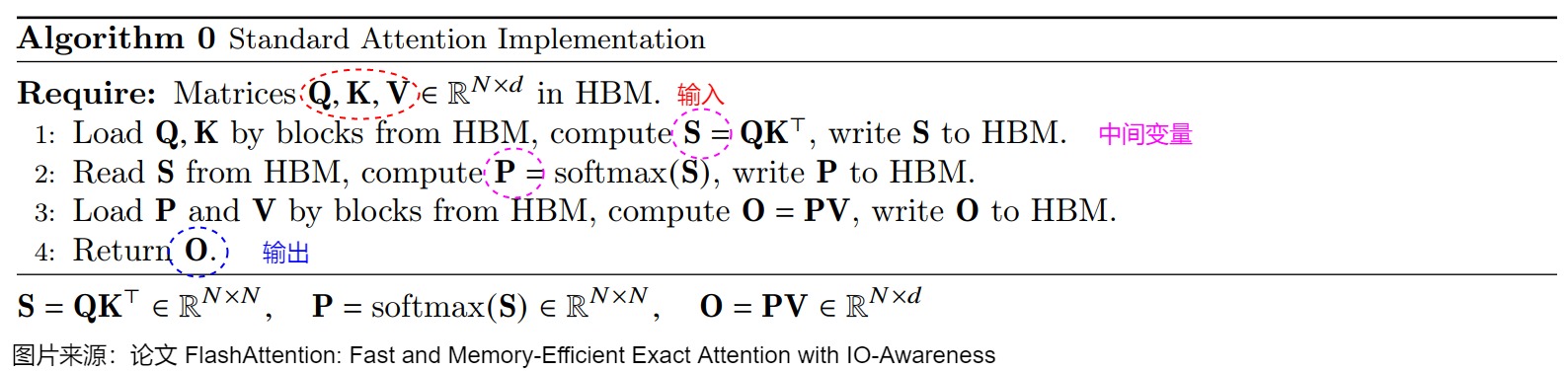
对应到 Attention 计算中,$x$ 就是将计算得到的 $S=QK^T$,对应的 shape 是 $(N, N)$ 。考虑到 GPU 的 SRAM 一般比较小,$S$ 由于需要 $O(N^2)$ 的显存无法放在 SRAM 中,比如 $N=4k$ 的时候,至少需要 $4k * 4k * 2 = 32M$ 字节的空间存储 $S$ 状态。而对于 GPU SRAM 一般比较小,随着 sequence length 增加,$S$ 状态一般是存储不下的。
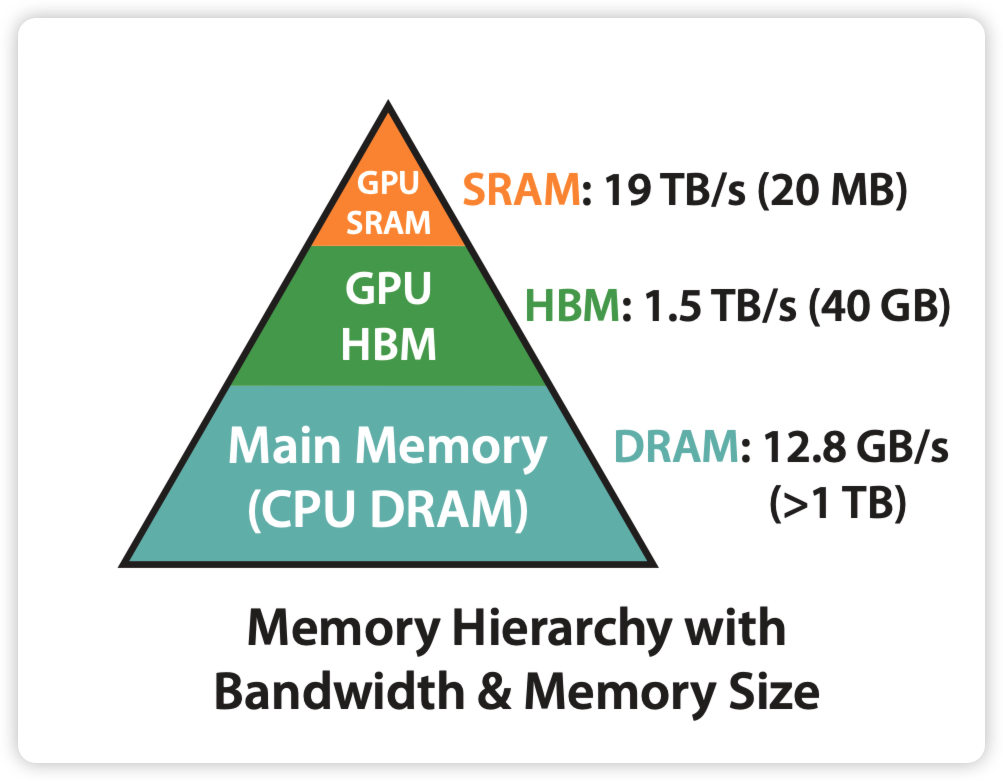
因此,这种状态下,只能每次循环中去 load 一部分 Q,K 到 SRAM,计算得到 $x$。按照 3 Pass 计算方法,我们要将 $x$ 从 Global Memory 取 3 次到 SRAM。
对应的代码实现如下所示:
|
|
Online Softmax: 2-pass
如果能够把上面的 7/8/9 三个公式合成一个,那么可以将访问 Global Memory 的次数从 3 次降低到 1 次。但是因为公式 8 依赖于公式 7 的 $m_N$,所以不能合并。
令 $d’i := \sum{j=1}^i e^{x_j - m_i}$ 作为原始公式 $d_i := \sum_{j=1}^i e^{x_j - m_N}$ 的替代,来移除对于 $N$ 的依赖。可以看到这两个公式的第 $N$ 个值是相等的: $d_N = d’_N$ ,因此,只要我们计算出了 $d’_N$ ,就可以用它来代替公式 9 的 $d_N$。
关于 $d’i$ 和 $d’{i-1}$ 之间的递推公式: $$ \begin{align*} d’i &= \sum{j=1}^i e^{x_j - m_i} \ &= \left( \sum_{j=1}^{i-1} e^{x_j - m_i} \right) + e^{x_i - m_i} \ &= \left( \sum_{j=1}^{i-1} e^{x_j - m_{i-1}} \right) e^{m_{i-1} - m_i} + e^{x_i - m_i} \ &= d’{i-1} e^{m{i-1} - m_i} + e^{x_i - m_i} \end{align*} $$
这里的递推公式只依赖于 $m_i$ 和 $m_{i-1}$, 因此可以在一个 loop 里一起计算 $m_j$ and $d’_j$

对应的代码如下所示:
|
|
Flash Attention: 1-pass
可以看到,online softmax 将遍历次数降低到 2 pass,那么是否还可以降低到 1 pass 呢?可以的是,对于 softmax 是不可以的。不过,对于 Attention,最终目标不是计算出 Attention $P=softmax(S)$,而是计算出 $O=PV$。对于 O 是否可以实现 1 pass 计算出来呢?
下面尝试计算第 $k$ 个 token 的 score,其中 $Q, K, V \in R^{N\times d}$,因此对应于 $Q$ 中的第 $k$ 行。而且每个 token 的 score 计算都是独立的,因此可以代表所有 token 的计算方法:

我们将公式 11 中的 $a_i$ 代入到公式 12,得到:
$$ \boldsymbol{o}i := \sum{j=1}^i \left( \frac{e^{x_j - m_N}}{d_N’} V[j,:] \right) \tag{13} $$
这个公式仍然依赖于 $m_N$ 和 $d_N$,同样适用替代目标 $\boldsymbol{o}’$,
$$
\boldsymbol{o}’i := \left( \sum{j=1}^i \frac{e^{x_j - m_i}}{d’_i} V[j,:] \right)
$$
同样有,对于 $\boldsymbol{o}$ and $\boldsymbol{o}’$ 第 $N$ 项是相同的: $\boldsymbol{o}’_N = \boldsymbol{o}_N$
我们可以得到 $\boldsymbol{o}’i$ and $\boldsymbol{o}’{i-1}$ 之间的递推公式:
$$
\begin{align*}
\boldsymbol{o}’i &= \sum{j=1}^i \frac{e^{x_j - m_i}}{d’_i} V[j,:] \
&= \left( \sum_{j=1}^{i-1} \frac{e^{x_j - m_i}}{d’_i} V[j,:] \right) + \frac{e^{x_i - m_i}}{d’_i} V[i,:] \
&= \left( \sum_{j=1}^{i-1} \frac{e^{x_j - m_{i-1}}}{d’{i-1}} \frac{e^{x_j - m_i}}{e^{x_j - m{i-1}}} \frac{d’_{i-1}}{d’_i} V[j,:] \right) + \frac{e^{x_i - m_i}}{d’_i} V[i,:] \
&= \left( \sum_{j=1}^{i-1} \frac{e^{x_j - m_{i-1}}}{d’{i-1}} V[j,:] \right) \frac{d’{i-1} e^{m_{i-1} - m_i}}{d’_i} + \frac{e^{x_i - m_i}}{d’_i} V[i,:] \
&= \boldsymbol{o}’{i-1} \frac{d’{i-1} e^{m_{i-1} - m_i}}{d’_i} + \frac{e^{x_i - m_i}}{d’_i} V[i,:]
\end{align*}
$$
$\boldsymbol{o}’i$ and $\boldsymbol{o}’{i-1}$ 只依赖于 $d’i$, $d’{i-1}$, $m_i$, $m_{i-1}$ and $x_i$,因此,我们就可以实现 1 pass 计算 flash attention

对应代码如下:
|
|
Flash Attention: Tiling
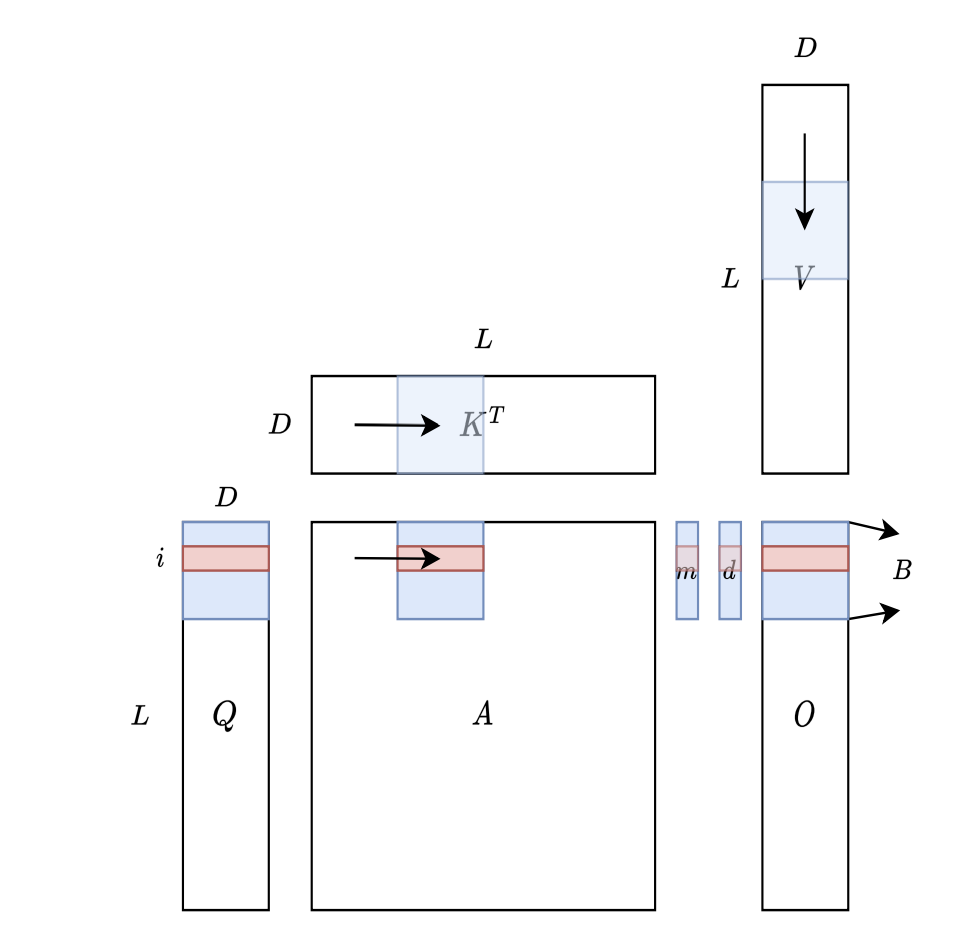
代码如下:
|
|
通过 FlashAttention,我们可以不用关注中间计算过程中 O 矩阵的正确性,只需要保证最终的 O 矩阵正确即可。
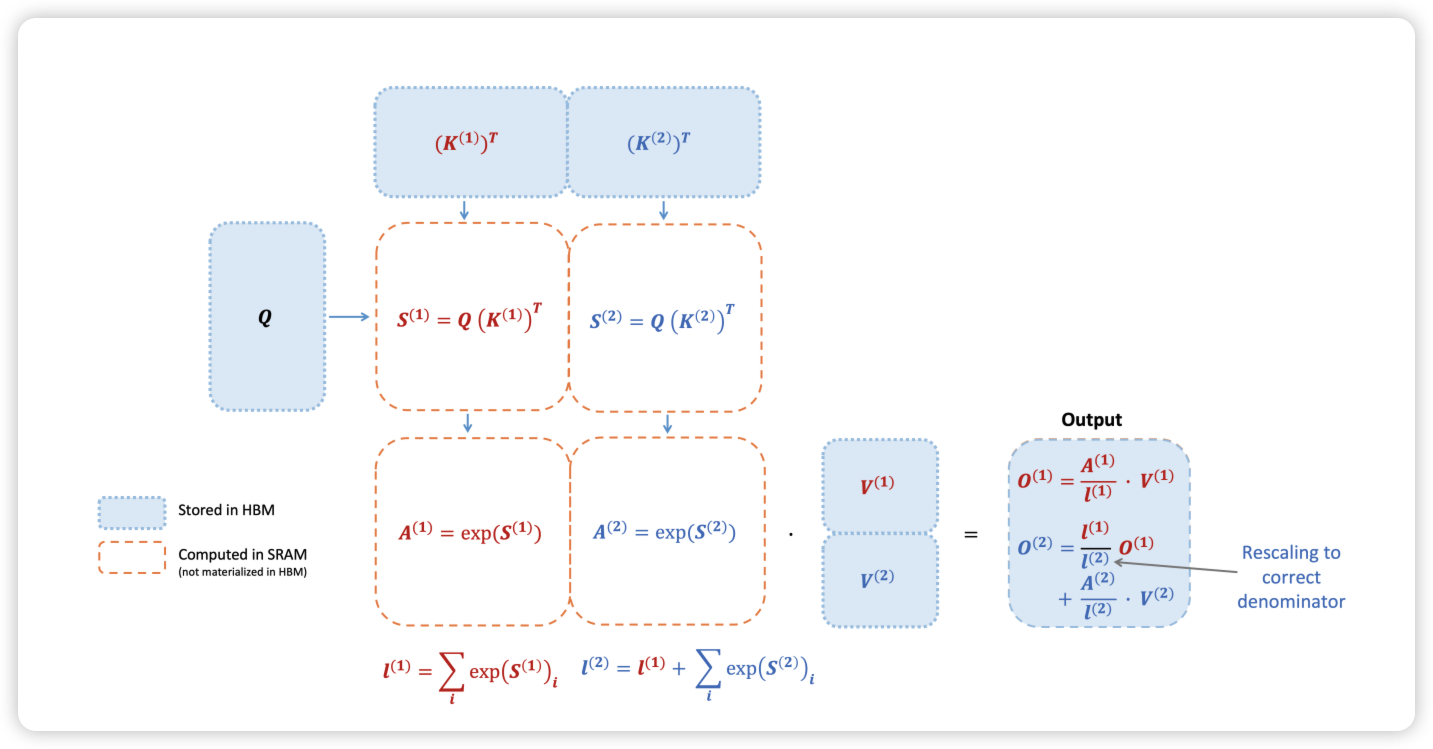
Flash Attention v1
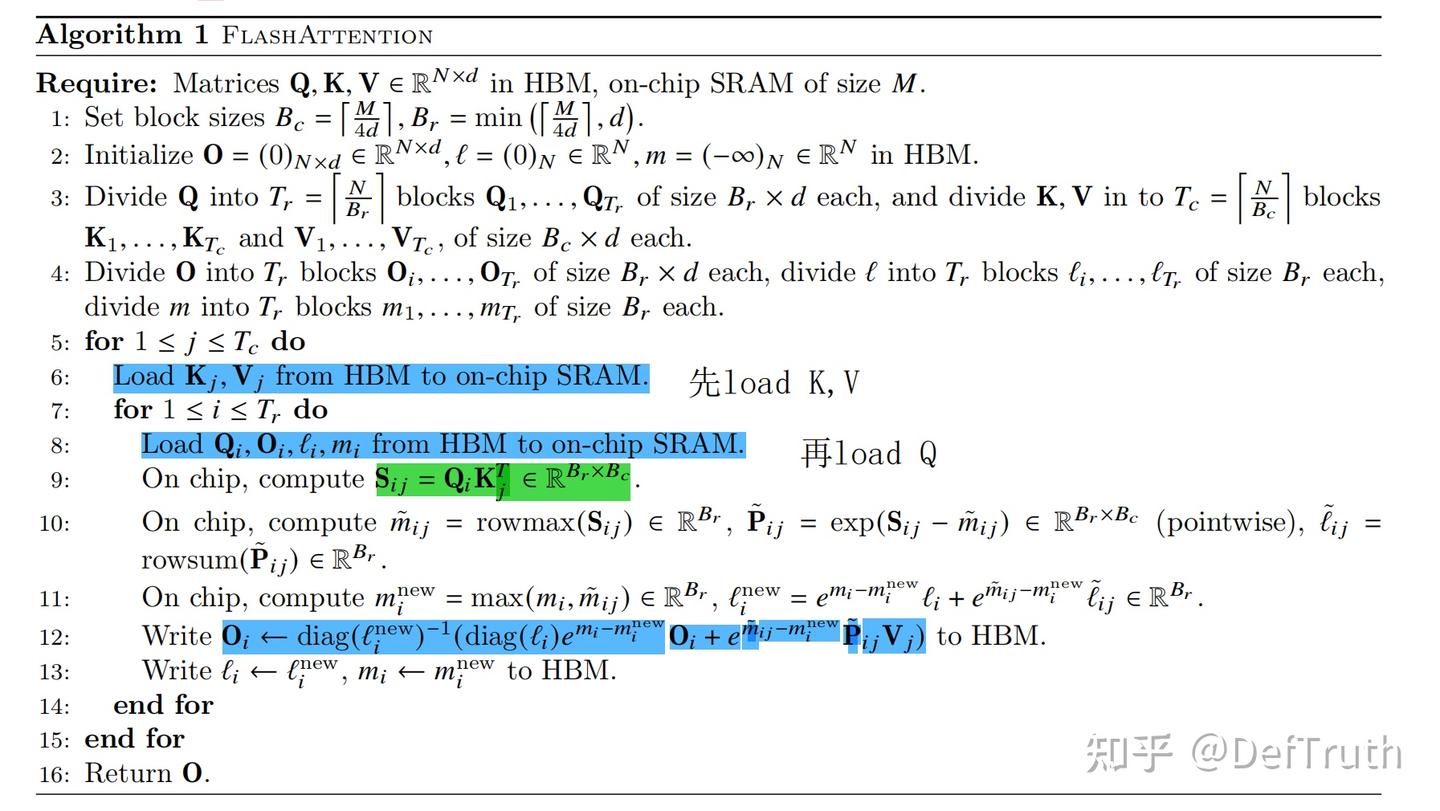
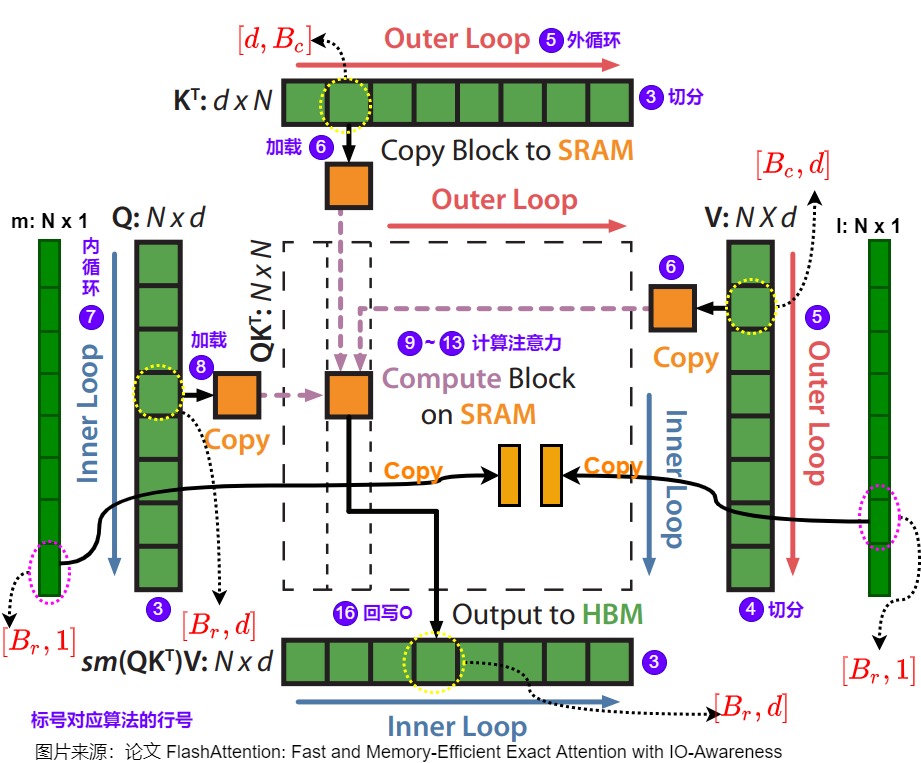
接下来对照论文伪代码,进一步理解 Flash Attention v1。
Forward Pass
$$
因为 $$\tilde{\mathbf{P}}{ij} = e^{\mathbf{S}{ij}-\tilde{m}{ij}}$$$$e^{\tilde{m}{ij}-m_i^{new}}\tilde{\mathbf{P}}{ij} = e^{\tilde{m}{ij}-m_i^{new}}e^{\mathbf{S}{ij}-\tilde{m}{ij}} = e^{\mathbf{S}_{ij}-m_i^{new}} $$
Backward Pass
前向计算流程如下,计算出 Attention $O$ 之后,继续前向传播得到损失 $L$。 $$ \begin{aligned} S &= QK^T \ P &= softmax(S) \ O &= PV \ L &= f(O) \ \end{aligned} $$ 反向时,假设已知 $\frac{\partial{L}}{\partial{O}}$,记做 $dO \in R^{N\times d}$ ,目标是求得 $\frac{\partial{L}}{\partial{Q}},\frac{\partial{L}}{\partial{K}},\frac{\partial{L}}{\partial{V}}$,即 $dQ, dK, dV \in R^{N\times d}$
$$ \begin{aligned} dV &= \frac{\partial{L}}{\partial{V}} = \frac{\partial{L}}{\partial{O}} \frac{\partial{O}}{\partial{V}} = P^T dO \ dP &= \frac{\partial{L}}{\partial{P}} = \frac{\partial{L}}{\partial{O}} \frac{\partial{O}}{\partial{P}} = dO V^T \ dS &= \frac{\partial{L}}{\partial{S}} = \frac{\partial{L}}{\partial{P}} \frac{\partial{P}}{\partial{S}} = dP \frac{\partial{P}}{\partial{S}} \ dQ &= \frac{\partial{L}}{\partial{Q}} = \frac{\partial{L}}{\partial{S}} \frac{\partial{S}}{\partial{Q}} = dS K \ dK &= \frac{\partial{L}}{\partial{K}} = \frac{\partial{L}}{\partial{S}} \frac{\partial{S}}{\partial{K}} = dS^T Q \ \end{aligned} $$ 其中 P 为 softmax (S),经过 softmax 中的求导推导,可以得出
$$ dS_{ij} = P_{ij}\left( dP_{ij} - \sum_l P_{il}dP_{il} \right) $$
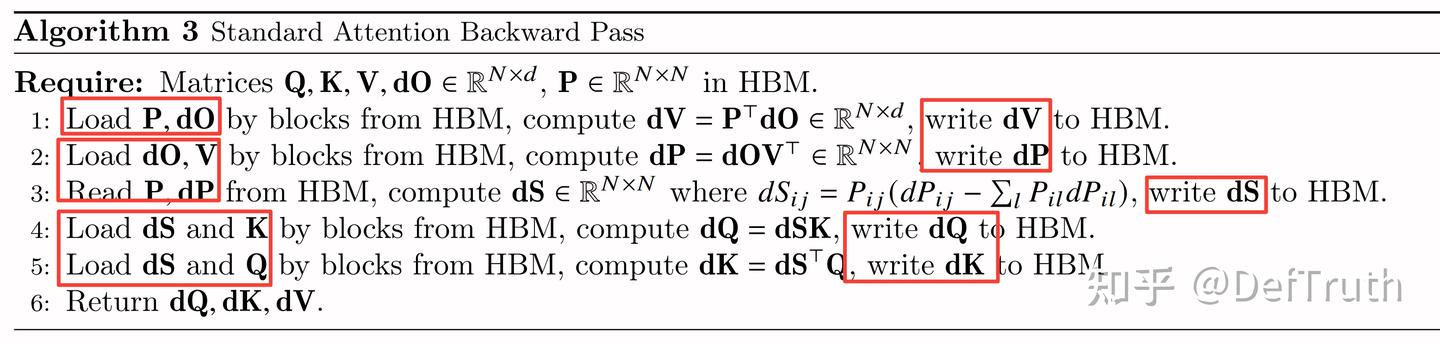
标准 Attention backward pass 计算如下:
对于 FlashAttention 的 backward 计算流程如下
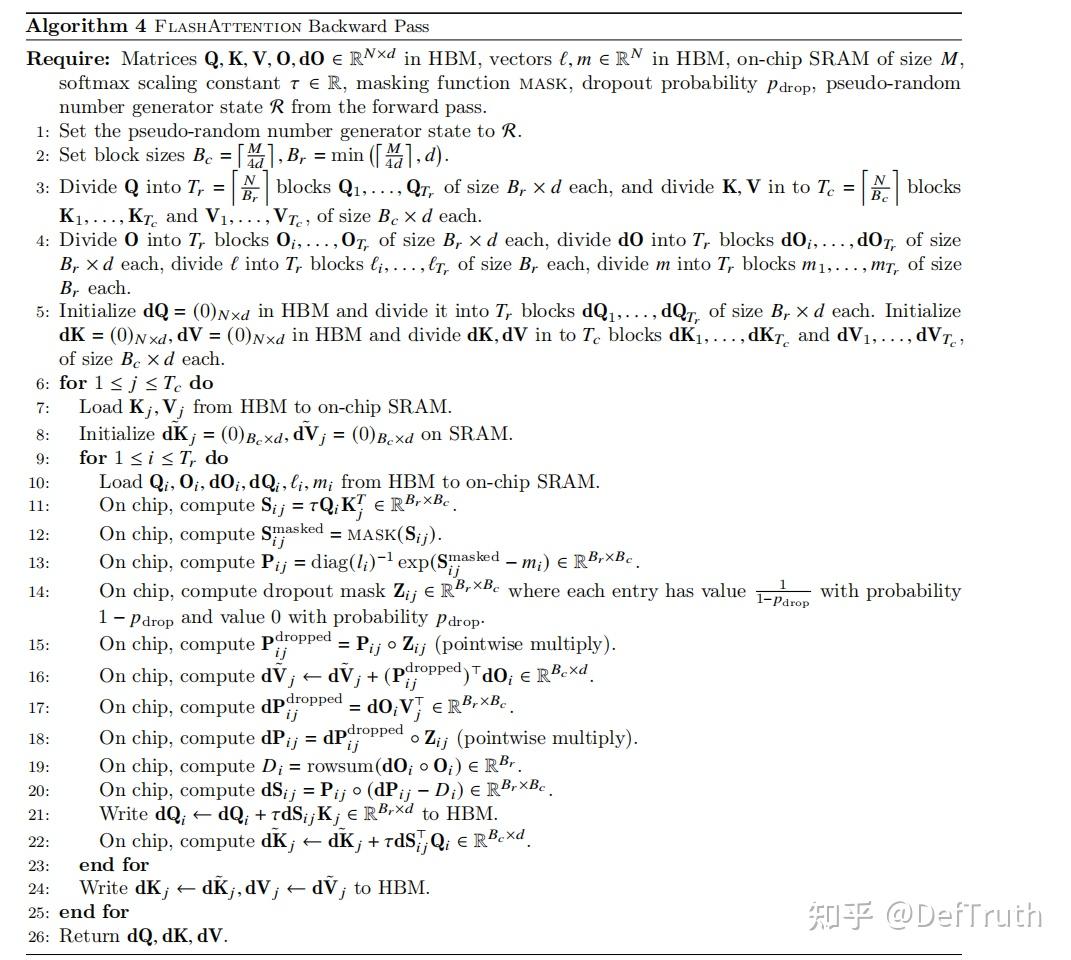
FlashAttention backward pass 最主要的优化就是:Recompute。对比 Standard Self Attention,FlashAttention 在前向不需要保留 S 和 P 矩阵,但是 backward pass 又需要 S 和 P 矩阵的值来计算梯度。那么怎么办呢?那自然就是就是和 forward 一样,利用 Tiling 技术,将 Q, K, V 分块 load 到 SRAM,然后通过 online recompute 计算得到当前块的 S 和 P 值。具体到 backward pass 中计算逻辑就是:
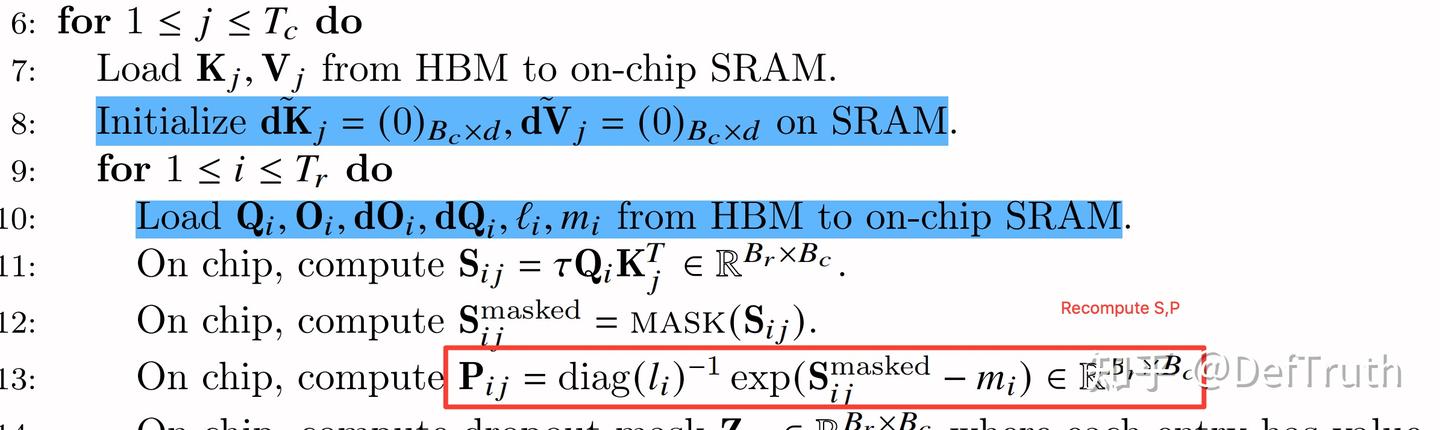
那么,这样做带来的优化是什么呢?首先,针对 Q,K,V 矩阵,无论是否有 recompute,都是必须要 load 到 SRAM 进行计算的,因为计算梯度需要。那么,没有 recompute 时,P 矩阵是事先算好保存在 HBM 中的,此时在 backward 时,需要 load Q,K,V,dO,dS + load P,dP + write dS,dP,dQ,dV,dK。
在使用了 recompute+tiling 后,则只需要 load Q,K,V,dO + write dQ,dV,dK,这个公式可能没有算的很精确,但总的意思就是关于 S,P,dS,dP 的 load/write IO 被消除了。虽然 recompute 增加了计算量 FLOPs,但是 IO 的减少带来的收益更大。按照 NV PTX ISA 8.1 6.6章节-Operand Costs 中的文档说明,GPU HBM IO Accesses 通常耗时>100 时钟周期,而计算指令一般只需要几个时钟周期。
Flash Attention v2
FlashAttention-2 相对于 FlashAttention-1,进一步改变了 Tiling 的顺序,将 Q 矩阵的循环挪到了最外层,这样就可以将 Q 矩阵的循环交给 Thread Block 来并行计算。也就是说,除了原来 batch 和 head 两个维度可以并行,现在也可以在 sequence 维度切分,三层循环分给不同的 thread block,进一步增加 GPU 的吞吐。
循环顺序调换之后,进一步的对同一个 block 中的 warp patition 做了优化,将 V1 版本中沿着 K 切共享 Q 变成 V2 中沿着 Q 切共享 K。每个 warp 执行矩阵乘法以获得 $QK^T$ 的切片,然后只需与 V 的共享切片相乘就能获得相应的输出切片。Warp 之间不需要通信,共享内存读写的减少也可以提升速度。
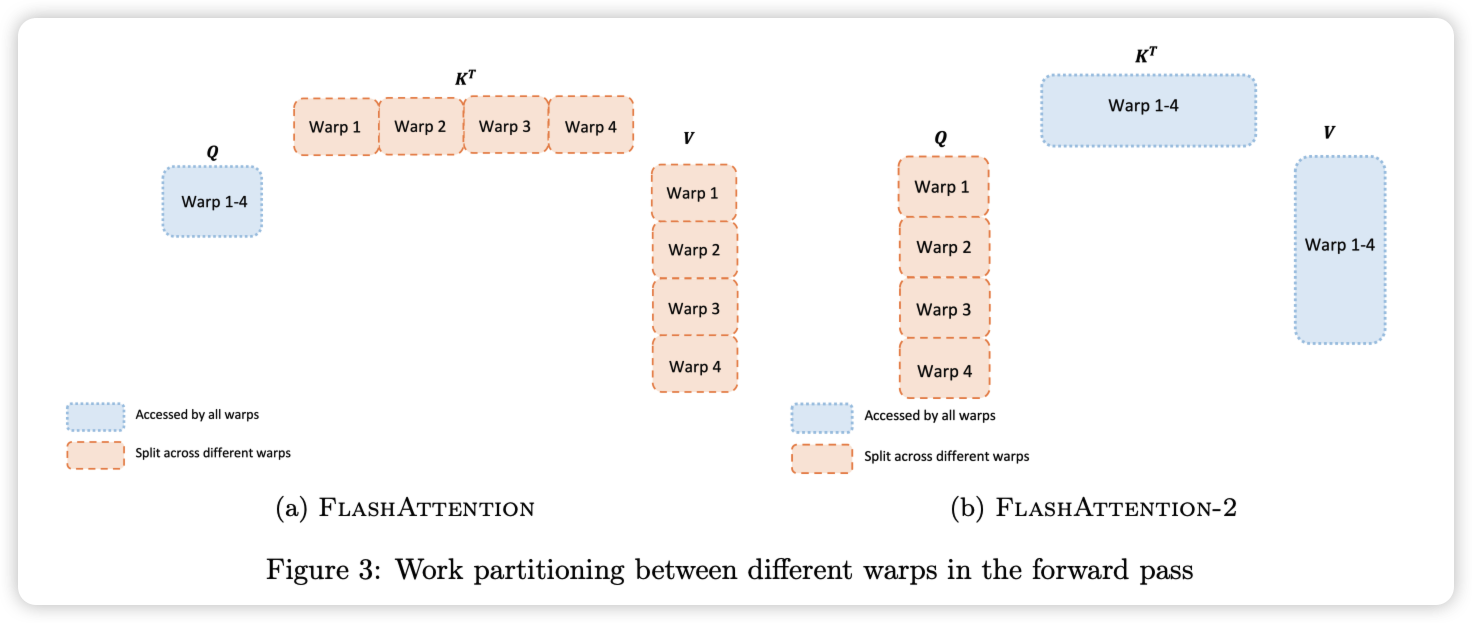
Forward Pass
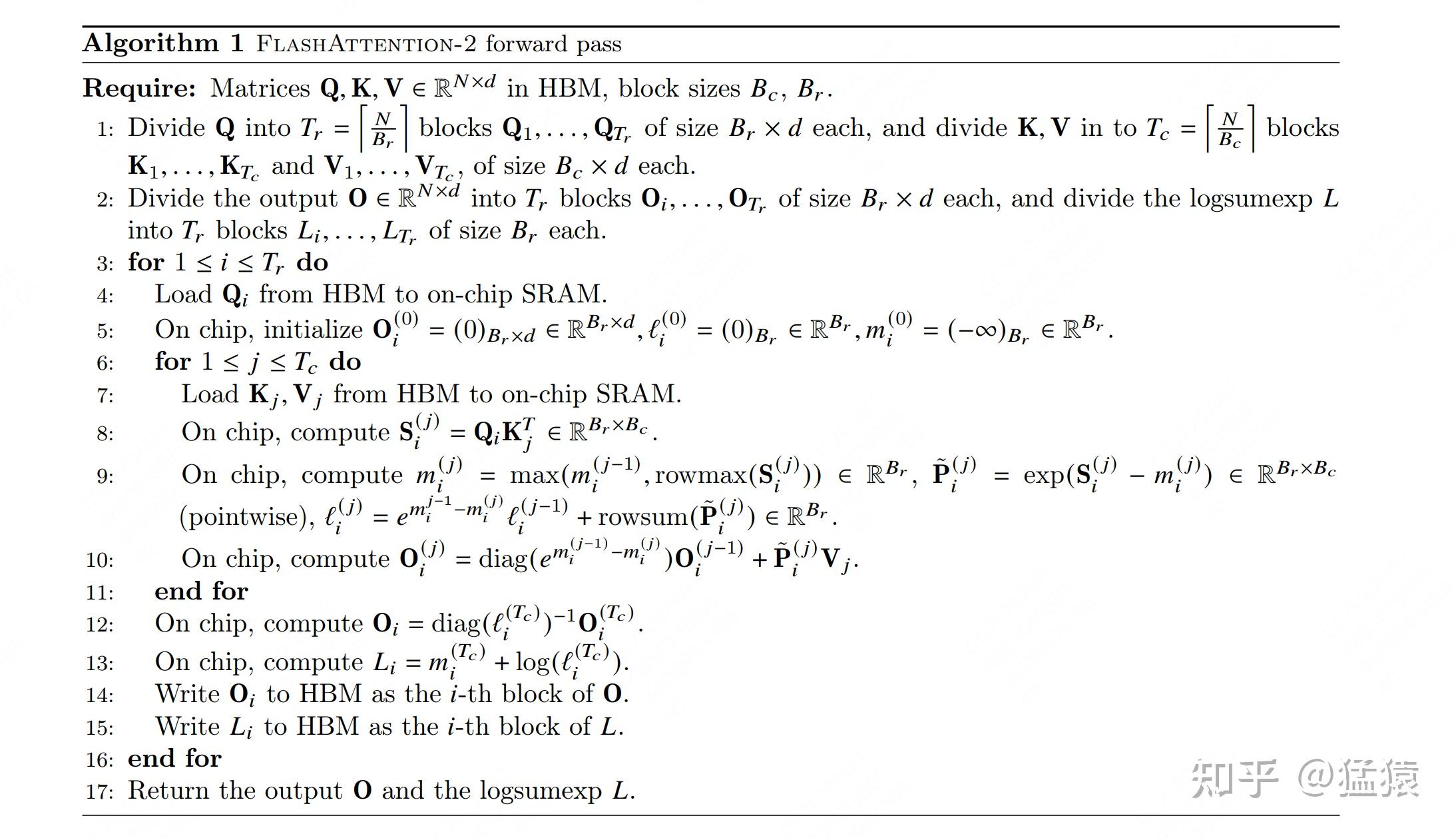
比起 V1,V2中不用再存每一 Q 分块对应的 $m_i$ 和 $l_i$ 了。但是在 BWD 的过程中,我们仍需要 $m_i, l_i$ 来做 $S_i^{(j)}$ 和 $P_i^{(j)}$ 的重计算,这样才能用链式求导法则把 dQ,dK,dV 正常算出来。
V2在这里用了一个很巧妙的方法,它只存一个东西(代码13行,这样又能进一步减少 shared memory 的读写):$L_i = m_i^{(T_c)} + log(l_i^{(T_c)})$,这个等式中小写的 m 和 l 可以理解成是全局的 rowmax 和 rowsum。在接下来 BWD 的讲解中,我们会来看到这一项的妙用。
Backward Pass
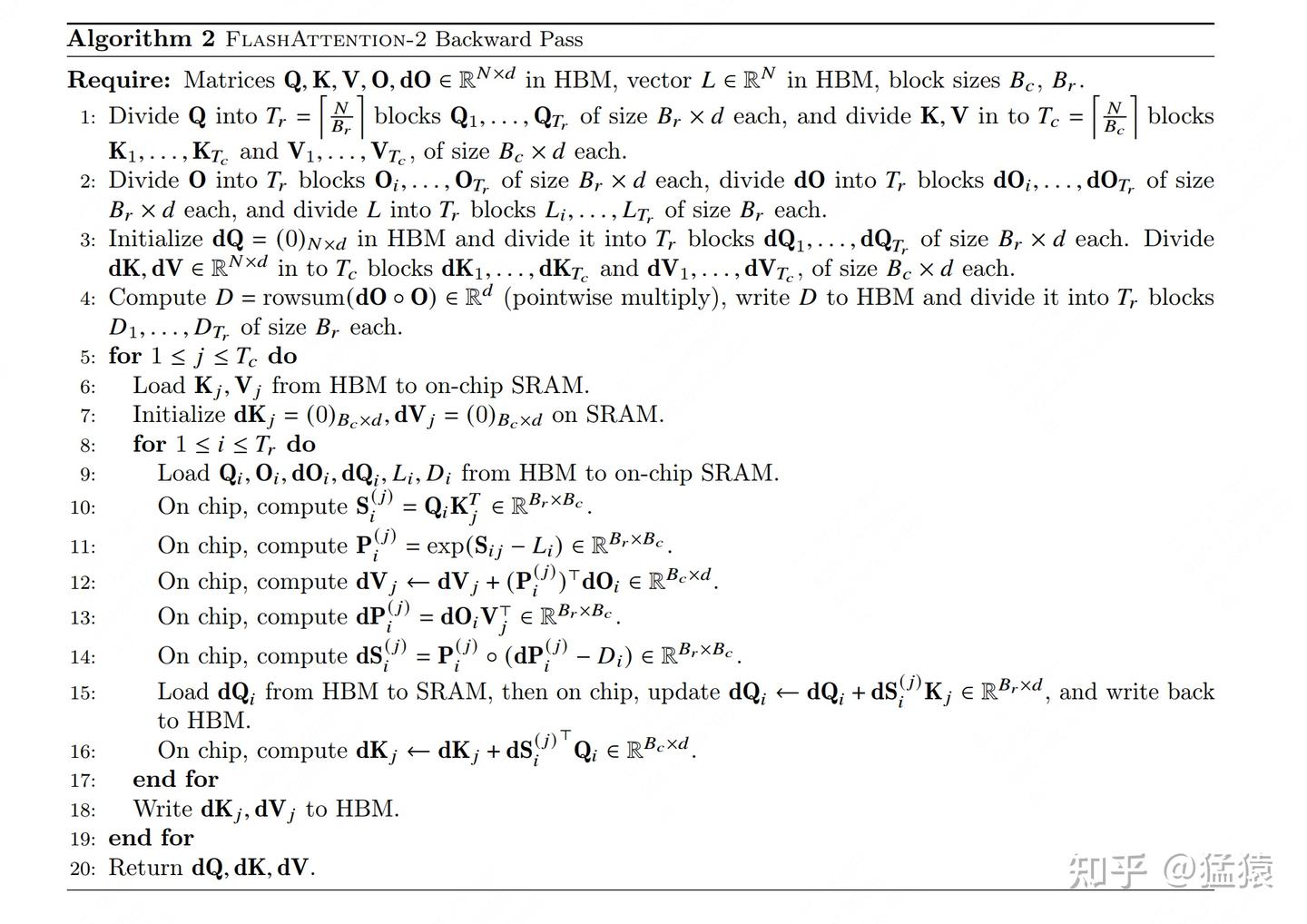
我们知道在BWD的过程中,我们主要是求$dV_j, dK_j, dQ_i$(为了求它们还需要求中间结果$dS_{ij}, dP_{ij}$),我们来总结一下这些梯度都需要沿着哪些方向AllReduce:
- $dV_j$:沿着$i$方向做AllReduce,也就是需要每行的结果加总
- $dK_j$:沿着$i$方向做AllReduce,也就是需要每行的结果加总
- $dQ_i$:沿着$j$方向做AllReduce,也就是需要每列的结果加总
- $dS_{ij}, dP_{ij}$:只与当前$ij$相关
基于此,如果你还是保持Q外循环,KV外循环不变的话,这种操作其实是固定行,遍历列的,那么在这些梯度中,只有$dQ_i$从中受益了,K和V的梯度则进入了别扭的循环(也意味着要往shared memory上写更多的中间结果);但如果你采用KV外循环,Q内循环,这样K和V都受益,只有Q独自别扭,因此是一种更好的选择。(S和P的计算不受循环变动影响)。
前面说过,在BWD过程中读写我们要用全局的$m_i^{(j)}, l_i^{(j)}$重新计算$P_i^{(j)}$,计算公式如下:
$$P_i^{(j)} = diag(l_i^{(j)})^{-1}exp(S_i^{(j)} - m_i^{(j)})$$
但如此一来,我们就要从shared memory上同时读取$m_i^{(j)}, l_i^{(j)}$,似乎有点消耗读写。所以在V2中,我们只存储$L_i = m_i^{(j)} + log(l_i^{(j)})$,然后计算:
$$P_i^{(j)} = exp(S_i^{(j)} - L_i)$$
很容易发现这两个计算是等价的,但V2的做法节省了读写量
参考
-
No backlinks found.